What It Really Tells You About the Northern Lights
If you’ve ever looked at a Northern Lights forecast, you’ve probably come across something called the Kp index. A number between 0 and 9, it is one of the most widely used indicators of geomagnetic activity and an important tool for understanding when the Aurora might appear.
But does a high Kp index guarantee an impressive display? And should you be disappointed if the forecast only shows Kp 2?
At Aurora Nights, understanding the science behind the Northern Lights is an important part of what we do. With more than 15 years of experience creating luxury Aurora holidays, and a team that lives and works across the Nordics, we know that forecasting the Northern Lights involves much more than watching a single number.
Our Aurora Academy was created to share that knowledge, helping travellers understand the science, forecasts and practicalities of witnessing one of nature’s most extraordinary displays.
What Is the Kp Index?
The Kp index is a scale from 0 to 9 that measures disturbances in Earth’s magnetic field, known as geomagnetic activity.
These disturbances are influenced by the interaction between Earth’s magnetic field and the solar wind, a continuous flow of charged particles from the Sun.
The Kp index combines measurements from a network of geomagnetic observatories around the world, producing a global measure of activity over three hour periods.
Generally speaking, the higher the Kp index, the greater the geomagnetic activity and the further south the Northern Lights may become visible.
However, the Kp index does not directly measure how bright the Northern Lights will appear at your particular location.
This distinction is especially important when you’re already travelling within the Arctic region.
What Do the Different Kp Levels Mean?
Understanding the scale helps you interpret Northern Lights forecasts more accurately.
Kp 0 to 1: Quiet Geomagnetic Conditions
Aurora activity is generally concentrated towards the northernmost regions. Displays may be relatively faint, but sightings can still be possible in locations beneath the auroral oval.
Kp 2 to 3: Typical Arctic Aurora Conditions
These are perfectly reasonable levels for Northern Lights viewing in destinations such as northern Norway, Sweden and Finland. You don’t need a geomagnetic storm to witness a beautiful Aurora display.
Kp 4: Increased Geomagnetic Activity
The Aurora may become more widespread and active, with opportunities for brighter displays and more movement across the night sky.
Kp 5 to 6: Geomagnetic Storm Conditions
Kp 5 marks the beginning of geomagnetic storm conditions. The auroral oval can extend further south, making sightings possible in locations that would not normally experience the Northern Lights.
Kp 7 to 9: Strong to Extreme Geomagnetic Storms
These less frequent events can produce widespread Aurora activity and spectacular displays across much larger geographical areas.
Even at these higher levels, visibility still depends on darkness, weather and local conditions.
Why a High Kp Index Doesn’t Guarantee Northern Lights
One of the biggest misconceptions about Aurora hunting is that a high Kp index automatically means you’ll see the Northern Lights.
You might have a forecast of Kp 7, indicating strong geomagnetic activity, but if thick clouds are covering the sky, you may not see anything at all.
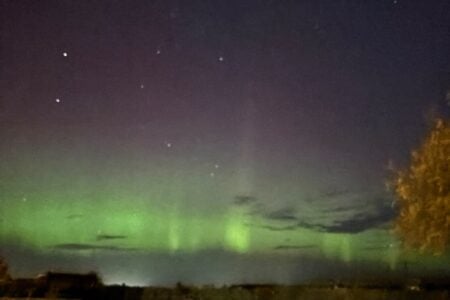
Equally, a Kp 2 or 3 forecast in northern Sweden or Finland could coincide with a beautiful display directly overhead.
The Kp index is a global measurement, rather than a precise forecast for one particular location.
Aurora activity can also change considerably throughout the evening, sometimes developing rapidly with little warning.
This is why experienced Northern Lights guides consider several different sources of information rather than relying entirely on the Kp index.
Why Local Weather Forecasts Matter Just as Much
Cloud cover is one of the most important factors influencing Northern Lights visibility.
If you have clear skies, even relatively modest Aurora activity can produce a memorable display.
Across the Nordics, weather conditions can vary significantly over relatively short distances.
In northern Norway, coastal weather can bring cloud, while inland locations may offer clearer conditions. In Swedish Lapland, the geography around Abisko can sometimes create favourable breaks in the cloud.
Finland’s northern wilderness offers extensive areas of dark sky, while Iceland’s rapidly changing weather makes careful planning and flexibility particularly valuable.
Our locally based guides understand these regional differences and use weather forecasts alongside Aurora predictions to identify the most promising viewing locations.
Sometimes travelling a relatively short distance can make all the difference.
Understanding More Than Just the Kp Index
For anyone interested in exploring the science further, there are other useful indicators of potential Northern Lights activity.
Solar wind speed, the strength of the interplanetary magnetic field and its north or south orientation, known as Bz, can all provide valuable information.
A sustained southward Bz is particularly interesting because it can allow energy from the solar wind to enter Earth’s magnetic environment more effectively, supporting geomagnetic activity.
However, no individual measurement can guarantee that the Aurora will appear at a particular time or place.
The Aurora Buddy App: Developed by Our CEO
Our interest in understanding and forecasting the Northern Lights goes well beyond planning holidays.
Aurora Nights founder and CEO, Jonny Cooper, developed the Aurora Buddy app, drawing on his fascination with the science of the Northern Lights and his experience of living with his family in Swedish Lapland.
The app helps travellers understand Aurora activity and potential viewing conditions, using scientific information to make Northern Lights forecasting more accessible.
It’s another useful resource for anyone hoping to witness the Aurora, whether you’re visiting the Arctic for the first time or returning to experience the Northern Lights again.
Explore the Science at Our Aurora Academy
Created by Aurora Nights, our Aurora Academy is a dedicated resource for anyone wanting to understand the Northern Lights in greater detail.
From discovering what causes the Aurora and why different colours appear, to learning when and where to see the Northern Lights, the Academy brings together information about the science and practicalities of Aurora viewing.
You’ll also find explanations of Northern Lights forecasts, seasonal viewing opportunities and advice on choosing the right Arctic destinations.
It’s knowledge built around our specialist experience and understanding of the places we call home.
Northern Lights Expertise Makes the Difference
The Northern Lights are a natural phenomenon, and even the most sophisticated forecasting tools cannot guarantee a sighting.
What makes a difference is understanding the information available, choosing appropriate destinations and knowing how local conditions influence your opportunities.
At Aurora Nights, our specialists combine scientific knowledge with firsthand experience, private guiding and carefully selected luxury accommodation across Norway, Sweden, Finland and Iceland.
Because when it comes to seeing the Northern Lights, understanding the forecast is important, but knowing what to do with that information matters just as much.